What is Exy?
What is Exy?
What is Exy?
Exy is a fictional sport invented by Nora Sakavic for the book series All For The Game.
It’s played on a soccer-sized court that has walls and ceilings made of plexiglass. The sport itself is considered to be similar to lacrosse, but with the aggression of ice hockey.
On the court a team consists of six players, each of which has a racquet they must use to shoot the ball at the goal, which is a rectangle marked on the shorter wall at either end of the court. The goal will light up red if it has been hit.
Exy is played in two forty-five minute halves with a fifteen minute halftime break, and the objective of the game is to out-score your opponent before the time is up.
Exy is a fictional sport invented by Nora Sakavic for the book series All For The Game.
It’s played on a soccer-sized court that has walls and ceilings made of plexiglass. The sport itself is considered to be similar to lacrosse, but with the aggression of ice hockey.
On the court a team consists of six players, each of which has a racquet they must use to shoot the ball at the goal, which is a rectangle marked on the shorter wall at either end of the court. The goal will light up red if it has been hit.
Exy is played in two forty-five minute halves with a fifteen minute halftime break, and the objective of the game is to out-score your opponent before the time is up.
Positions
On the court there are always: 2 strikers, 2 backliners, 1 dealer, and 1 goalkeeper.
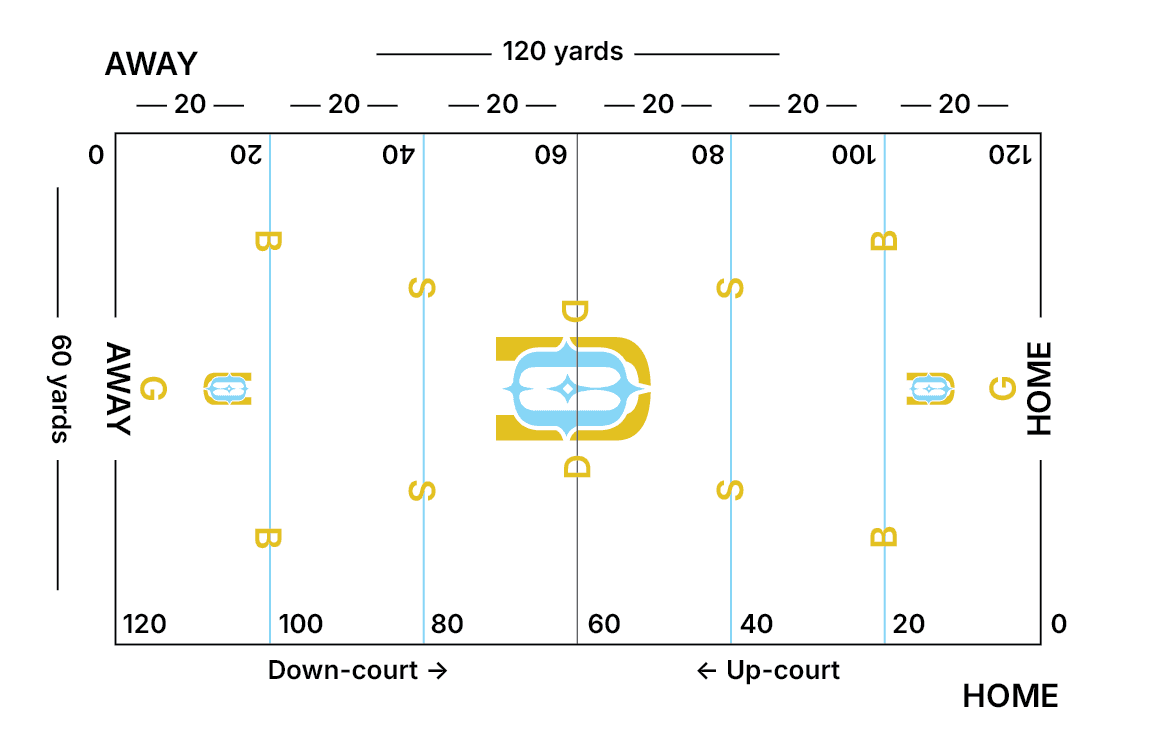
Strikers are the offensive line, responsible for scoring points. On the serving team, Strikers are allowed a 3 step advantage upon the referee’s signal. They start on the 40 yard line.
Dealers serve the ball at the start of a play, and are thereafter a middleman. They have the option to play offense or defense during the game, functioning as a makeshift striker or backliner depending on how the game is going. They start at center-court.
Backliners are the defensive line, responsible for protecting the goal. They mark Strikers, and must stand between them and the goal at all times if the Striker does not have possession of the ball. They start on the 20 yard line.
Goalkeepers guard the goal.
On the court there are always: 2 strikers, 2 backliners, 1 dealer, and 1 goalkeeper.
Strikers are the offensive line, responsible for scoring points. On the serving team, Strikers are allowed a 3 step advantage upon the referee’s signal. They start on the 40 yard line.
Dealers serve the ball at the start of a play, and are thereafter a middleman. They have the option to play offense or defense during the game, functioning as a makeshift striker or backliner depending on how the game is going. They start at center-court.
Backliners are the defensive line, responsible for protecting the goal. They mark Strikers, and must stand between them and the goal at all times if the Striker does not have possession of the ball. They start on the 20 yard line.
Goalkeepers guard the goal.
Equipment
Racquets vary by position in terms of depth and weight. Dealers have the deepest nets so they can easily deliver the ball between offense and defense. Strikers have shallower nets, with enough give to line up a shot. Backliner racquets have just a little give, as they are discouraged from carrying the ball—maintaining the ball near the goal allows opposing strikers to take possession. Goalkeeper racquets are flat, and are also the largest of the racquets.
Racquet weights are negotiable—generally speaking, racquets are lighter on the offensive line and are made of aluminum, whereas they tend to be heavier on the defensive line and are made of wood.
Helmets are required to be worn on the court at all times. A visor goes in front of the eyes to provide an unobstructed view of the court, and grating protects the face from the nose down.
Armor in the form of chest and shoulder padding, neck, shin, and arm guards, and armored gloves are a mandatory part of the Exy uniform. Additional protective gear like thigh padding and mouth guards are optional.
Racquets vary by position in terms of depth and weight. Dealers have the deepest nets so they can easily deliver the ball between offense and defense. Strikers have shallower nets, with enough give to line up a shot. Backliner racquets have just a little give, as they are discouraged from carrying the ball—maintaining the ball near the goal allows opposing strikers to take possession. Goalkeeper racquets are flat, and are also the largest of the racquets.
Racquet weights are negotiable—generally speaking, racquets are lighter on the offensive line and are made of aluminum, whereas they tend to be heavier on the defensive line and are made of wood.
Helmets are required to be worn on the court at all times. A visor goes in front of the eyes to provide an unobstructed view of the court, and grating protects the face from the nose down.
Armor in the form of chest and shoulder padding, neck, shin, and arm guards, and armored gloves are a mandatory part of the Exy uniform. Additional protective gear like thigh padding and mouth guards are optional.
Court
An Exy court is 60 yards wide, 120 yards long, and 10 yards tall. It is completely enclosed by a half-inch thick plexiglass that is primarily used for rebounds and passing.
The court is divided into sixths by five lines: first-court (20 yard line), second-court (40 yard line), half-court (60 yard line), third-court (80 yard line), and fourth-court (100 yard line).
Penalty shots are taken from marked spots halfway between first-court/fourth-court (20 vs 100 yard line) and the Home/Away goal.
An Exy court is 60 yards wide, 120 yards long, and 10 yards tall. It is completely enclosed by a half-inch thick plexiglass that is primarily used for rebounds and passing.
The court is divided into sixths by five lines: first-court (20 yard line), second-court (40 yard line), half-court (60 yard line), third-court (80 yard line), and fourth-court (100 yard line).
Penalty shots are taken from marked spots halfway between first-court/fourth-court (20 vs 100 yard line) and the Home/Away goal.
Rules
An offensive player who does not have possession of the ball, or is moving to take possession of the ball, must have an opposing defensive player (mark) between themself and the opposing goal keeper at all times. This prevents strikers from waiting near the goal to score, and failure to comply results in a complete reset.
Body checks are allowed against players who have possession of the ball, who have just relinquished it, or who are about to receive it. Players currently in possession of the ball may body-check another player without restriction. A faulty body check results in loss of possession and a reset to the nearest court line.
Any other form of fighting is prohibited and will result in a card. The severity decides whether the card is yellow or red, thus determining whether a team deserves a penalty shot or a simple loss in possession.
“Stick checks” are allowed only between racquets. If a player strikes another player’s body with their racquet they will be carded and the opposing team will receive a penalty shot. A stick check against another player’s helmet is an immediate red card, earning the opposing team a penalty shot.
Balls may only be carried for 10 steps, at which point they must be passed. Acceptable passes are to a teammate, oneself via rebound, or a shot on goal. At the start of a match, strikers are allowed a 3 step advantage.
One yellow card is a warning, two result in the player sitting out the remainder of the game. A player who is red-carded is immediately expelled from the ongoing game and must sit out of the next one as well.
An offensive player who does not have possession of the ball, or is moving to take possession of the ball, must have an opposing defensive player (mark) between themself and the opposing goal keeper at all times. This prevents strikers from waiting near the goal to score, and failure to comply results in a complete reset.
Body checks are allowed against players who have possession of the ball, who have just relinquished it, or who are about to receive it. Players currently in possession of the ball may body-check another player without restriction. A faulty body check results in loss of possession and a reset to the nearest court line.
Any other form of fighting is prohibited and will result in a card. The severity decides whether the card is yellow or red, thus determining whether a team deserves a penalty shot or a simple loss in possession.
“Stick checks” are allowed only between racquets. If a player strikes another player’s body with their racquet they will be carded and the opposing team will receive a penalty shot. A stick check against another player’s helmet is an immediate red card, earning the opposing team a penalty shot.
Balls may only be carried for 10 steps, at which point they must be passed. Acceptable passes are to a teammate, oneself via rebound, or a shot on goal. At the start of a match, strikers are allowed a 3 step advantage.
One yellow card is a warning, two result in the player sitting out the remainder of the game. A player who is red-carded is immediately expelled from the ongoing game and must sit out of the next one as well.
NCAA News
Former UXL backliner Dan Heng transfers to UO for his 4th year
PSU senior rescues man from burning vehicle
UO sophomore on new captain: ‘He knows exactly what everyone wants and how much they're willing to pay’
HSIT sophomore wins nationwide hackathon, laughs at competitors
UO striker Stelle named as Vice Captain after only being on the team for 1 year
UXL Captain on UXY: ‘We couldn't be more different in terms of temperament and how we handle things’
HSPN (HSR Sports Programming Network) is a fan-created universe inspired by the game Honkai Star Rail and the book series All for the Game. It is not affiliated with or endorsed by Hoyoverse or Nora Sakavic.
The original characters, settings, and stories belong to Hoyoverse or Nora Sakavic. Website designed by Cassia (KHASL4NAS), inspired by ESPN. Original story content written by Jai (Strifeless). All rights reserved.
HSPN (HSR Sports Programming Network) is a fan-created universe inspired by the game Honkai Star Rail and the book series All for the Game. It is not affiliated with or endorsed by Hoyoverse or Nora Sakavic.
The original characters, settings, and stories belong to Hoyoverse or Nora Sakavic. Website designed by Cassia (KHASL4NAS), inspired by ESPN. Original story content written by Jai (Strifeless). All rights reserved.
HSPN (HSR Sports Programming Network) is a fan-created universe inspired by the game Honkai Star Rail and the book series All for the Game. It is not affiliated with or endorsed by Hoyoverse or Nora Sakavic.
The original characters, settings, and stories belong to Hoyoverse or Nora Sakavic. Website designed by Cassia (KHASL4NAS), inspired by ESPN. Original story content written by Jai (Strifeless). All rights reserved.